
When replacing your windows, one of the most important decisions is not just which window you choose.
It is how that window is installed.
Homeowners in Ontario will often hear terms like retrofit installation, insert window installation, full-frame replacement, and brick-to-brick window replacement. These terms can sound technical, but they matter because the installation method can affect the final look, glass size, cost, disruption, energy performance, and long-term durability of your project.
At NTI Windows & Doors, we believe homeowners should understand the difference before making a decision.
Because the truth is simple:
The right choice depends on your home – not a sales script.
Retrofit vs Brick-to-Brick Window Replacement
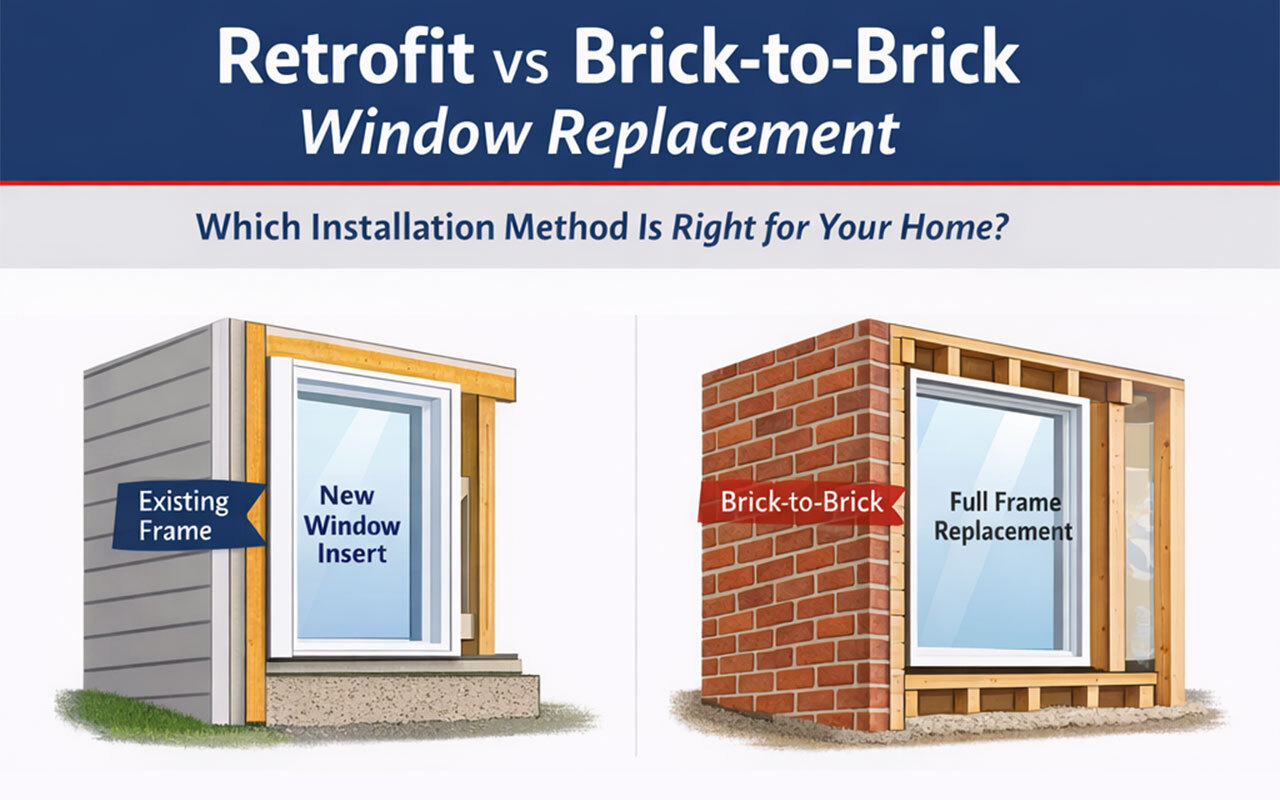
A retrofit window installation, also known as an insert window installation, keeps the existing window frame in place. The old operating parts of the window are removed, and the new window is installed inside the existing frame.
A brick-to-brick window replacement, also known as a full-frame window replacement, removes the old window and frame system more completely. This allows the installer to access the rough opening, inspect the condition of the surrounding structure, replace compromised liners or wood where needed, and size the new window as large as the opening properly allows.
In simple terms:
Retrofit installation keeps more of the existing structure.
Brick-to-brick installation removes and replaces more of the window system.
Retrofit is usually faster, less invasive, and lower in cost.
Brick-to-brick is usually more complete, more labour-intensive, and better suited when the existing frame or rough opening needs a proper reset.
Neither method is automatically right for every home.
The right choice depends on your home – not a sales script.
What Is Retrofit Window Replacement?
Retrofit window replacement means the new window is installed into the existing window frame.
Instead of removing the entire old frame, the installer removes the old sashes or operating parts and places the new replacement window inside the remaining frame structure.
This method can make sense when the existing window frame is still in good condition.
A retrofit installation may be suitable when:
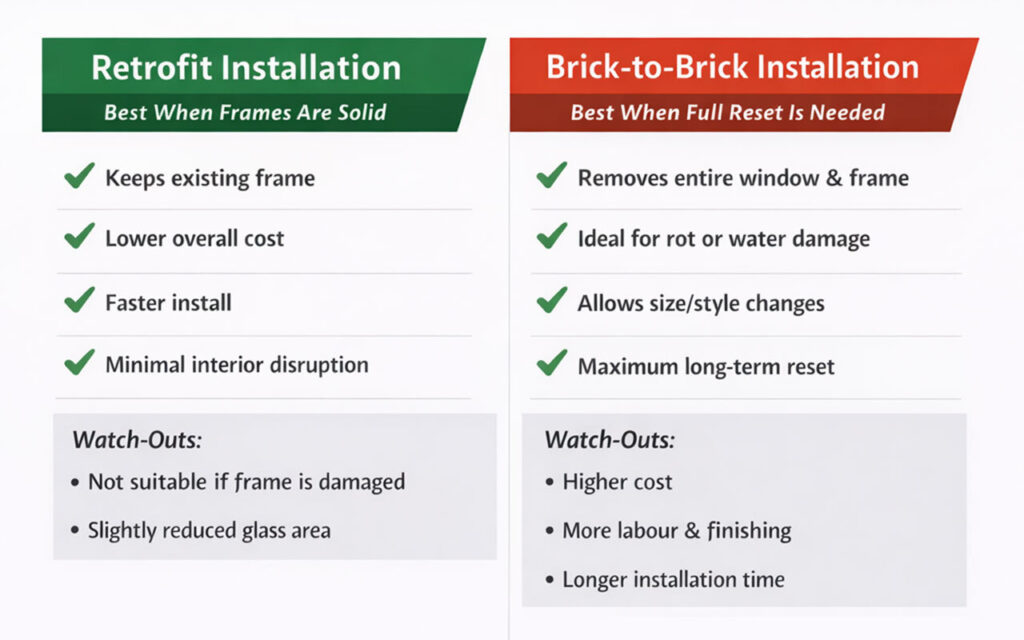
- The existing frame is solid
- There are no signs of rot or water damage
- The frame is reasonably square and level
- The homeowner wants less disruption to the interior
- The existing trim or exterior finish is still in good condition
- The homeowner wants a more budget-conscious option
- The opening does not require major correction
Retrofit installation can be a practical option for the right home.
But the key phrase is the right home.
A retrofit installation depends heavily on the condition of what is already there. If the existing frame is damaged, poorly sealed, rotted, out of square, or hiding water issues, installing a new window inside that frame does not solve the underlying problem.
It may make the window look newer, but it does not necessarily correct the opening.
That distinction matters.
At NTI Windows & Doors, we do not believe in pretending every home needs the exact same installation method. Retrofit can be a good option when the existing conditions support it. The issue is when retrofit is used as a shortcut without properly assessing the condition of the frame and surrounding opening.
What Are the Benefits of Retrofit Window Installation?
Retrofit window installation is popular because it can offer several practical benefits.
1. Lower Overall Cost
Retrofit installation usually costs less than brick-to-brick replacement because it involves less removal, less labour, and less finishing work.
Since the existing frame and surrounding trim are typically left in place, there is often less material and time involved.
For homeowners replacing multiple windows, that cost difference can matter.
2. Faster Installation
Because retrofit installation does not require full frame removal, the installation process is usually faster.
This can reduce the amount of time crews are working in the home and may make the project easier to schedule.
3. Less Interior Disruption
Retrofit installation can often preserve existing interior trim, casing, stool, apron, or surrounding finishes.
For homeowners who recently painted, renovated, or want to avoid additional finishing work, this can be appealing.
4. Good Option When Existing Frames Are Solid
When the existing window frame is in good shape, retrofit may be a smart and efficient installation method.
The problem is not retrofit itself.
The problem is using retrofit when the existing conditions do not support it.
What Should Homeowners Watch Out for With Retrofit?
Retrofit installation has limitations.
The most important one is that the existing frame stays in place. That means any hidden issues in or around that frame may remain hidden unless properly assessed.
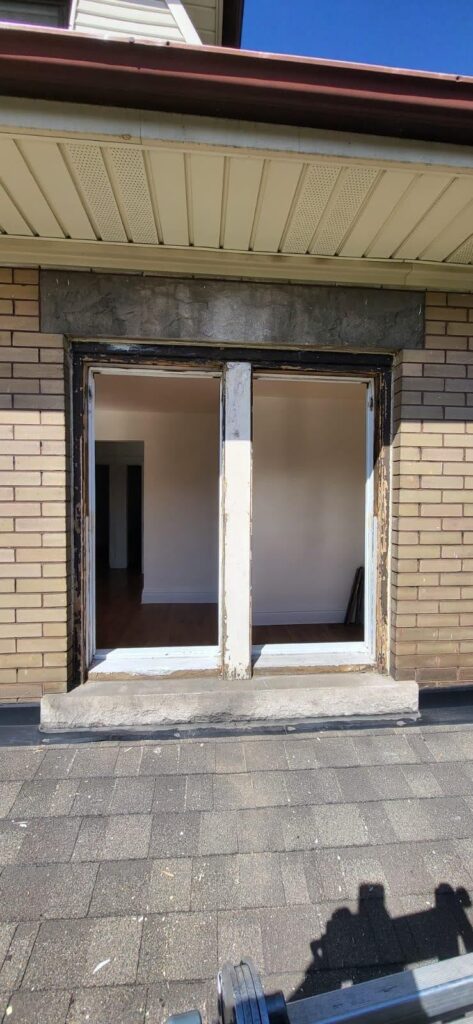
Homeowners should be cautious if there are signs of:
- Rot
- Water staining
- Soft or damaged wood
- Drafts around the window
- Previous leaks
- Poor previous installation work
- Frames that are badly out of square
- Visible deterioration around the opening
Another common trade-off is reduced glass area.
Because the new window is installed inside the existing frame, the replacement window may be smaller than what could be achieved with a full-frame or brick-to-brick installation.
That does not mean retrofit is wrong.
It simply means homeowners should understand the trade-off before choosing it.
A cheaper-looking installation is not always cheaper if it leaves behind a problem that should have been corrected. That is why the condition of the existing frame and opening matters so much.
What Is Brick-to-Brick Window Replacement?
Brick-to-brick window replacement, also called full-frame window replacement, removes the old window system more completely.
Instead of keeping the existing frame in place, the old window and frame are removed back to the rough opening.
This gives the installer access to the structure around the window. That access is important because it allows the installer to diagnose the condition of the rough opening, correct issues where needed, replace compromised liners or wood, insulate properly, and rebuild the window opening with a more complete approach.
A brick-to-brick installation may include:
- Removing the existing window
- Removing the old frame
- Diagnosing the condition of the rough opening
- Inspecting for rot, moisture damage, or compromised wood
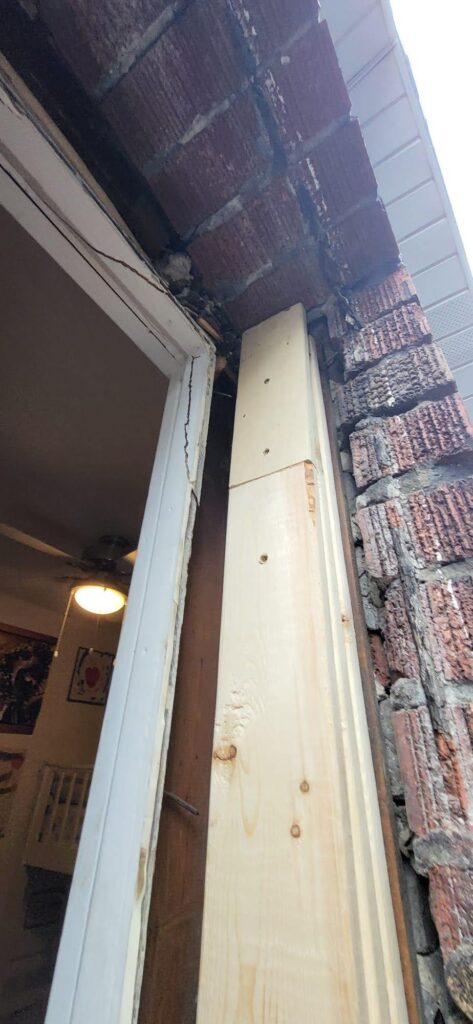
- Replacing compromised wood liners where required
- Measuring for the largest properly sized replacement window the opening allows
- Installing the new window into a properly prepared opening
- Properly insulating around the new window
- Air sealing and water sealing the opening
- Installing new exterior brickmould or capping where applicable
- Installing new interior jambs, casing, stool, or apron where required
Brick-to-brick replacement is usually the more complete installation method.
It gives the installer more control over the opening and allows more of the old system to be corrected or replaced.
This is why it often costs more.
There is more labour, more material, more finishing, and more responsibility involved.
What Are the Benefits of Brick-to-Brick Window Replacement?
Brick-to-brick replacement is often recommended when a home needs more than just a new window inserted into an existing frame.
1. More Complete Removal
With brick-to-brick installation, the old window and frame are removed more fully.
This allows the installer to see what is happening around the opening rather than simply covering over the existing frame.
That matters because window replacement is not just about the window itself. The window depends on the condition of the opening it is installed into.
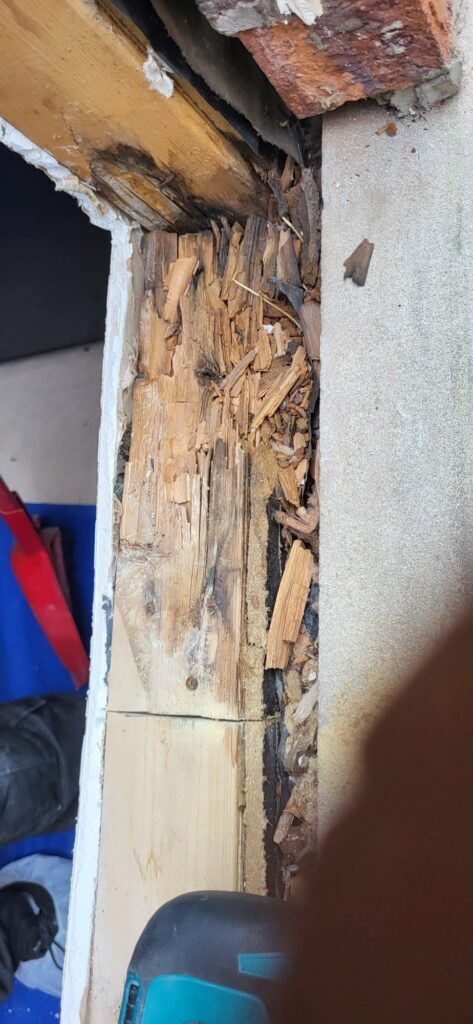
2. Better for Rot or Water Damage
If there is rot, water damage, or signs of past leaking, brick-to-brick is often the better choice.
Keeping a damaged frame in place and installing a new window inside it is usually not the right solution.
A new window is only as good as the opening it is installed into.
3. Allows for Better Rough Opening Inspection and Preparation
One of the biggest advantages of brick-to-brick replacement is access.
Once the old window and frame are removed, the installer can properly inspect the rough opening. This matters because the rough opening is the structure the new window depends on.
With full access, the installer can check the condition of the wood, identify signs of rot or moisture damage, correct compromised areas, and replace wood liners where needed before the new window is installed.
This gives the installation team a much better opportunity to prepare the opening properly, improve insulation, and address air and water sealing details.
A quality window should not be installed over hidden problems. Brick-to-brick replacement gives the installer the chance to find those problems and deal with them properly.
4. Allows the Window to Be Sized as Large as Properly Possible
Another major benefit of brick-to-brick replacement is that it allows the new window to be sized as large as the opening properly allows.
With retrofit installation, the new window is installed inside the existing frame, which usually means some glass area is lost. With brick-to-brick replacement, the old frame is removed, giving the installer more room to work with and allowing the replacement window to be measured closer to the full available opening.
This can help maximize glass area, improve natural light, and create a cleaner finished look.
Not every opening can or should be enlarged, and proper clearances still matter. But brick-to-brick replacement generally gives the best opportunity to install the largest appropriate window for that opening.
5. Strong Long-Term Reset
For older homes, poorly installed windows, or openings with unknown conditions, brick-to-brick can provide a more complete long-term reset.
It is not just about replacing the window.
It is about properly addressing the window opening.
That is where proper installation separates itself from a basic window swap.
What Should Homeowners Watch Out for With Brick-to-Brick?
Brick-to-brick replacement is more complete, but it also comes with trade-offs.
Homeowners should expect:
- Higher cost
- More labour
- More finishing work
- Longer installation time
- More disruption compared to retrofit
- Possible interior trim replacement
- Possible exterior finishing or capping work
That does not make brick-to-brick a bad option.
It simply means the scope is larger.
If one quote is for retrofit and another quote is for brick-to-brick, those quotes are not the same.
A lower price does not always mean a better deal.
Sometimes it means less work is included.
This is why homeowners need to understand exactly what installation method is being quoted.
Why Does Brick-to-Brick Usually Cost More?
Brick-to-brick window replacement usually costs more because the crew is doing more work.
The installation involves more removal, more preparation, more materials, and more finishing.
Instead of installing a new window into an existing frame, the installer is removing the full existing window system and rebuilding the opening more completely.
That may include new jambs, casing, brickmould, capping, insulation, sealing details, liner replacement, and additional labour.
This is why comparing a retrofit quote to a brick-to-brick quote can be misleading.
If two companies are quoting different installation methods, the prices are not directly comparable.
One company may look cheaper because they are quoting a less invasive installation.
Another may look more expensive because they are including a more complete scope of work.
The homeowner sees a price difference.
But the real difference may be the installation method.
Does Retrofit Reduce Glass Size?
In many cases, yes.
Retrofit installation can reduce visible glass area because the new window is installed inside the existing frame.
That existing frame takes up space. Since the new unit sits within that frame, the final glass area may be smaller than what could be achieved with a full-frame or brick-to-brick replacement.
For some homeowners, this is not a major concern.
For others, especially those who want to maximize natural light, it can matter.
This is one of the strongest reasons brick-to-brick replacement may be preferred. By removing the old frame, the installer has the opportunity to size the new window as large as the opening properly allows.
A proper consultation should explain not only the window style and price, but also how the installation method may affect the finished glass size and final appearance.
Is Retrofit Installation Bad?
No.
Retrofit installation is not automatically bad.
That is too simplistic.
Retrofit can be a good option when the existing frame is solid, dry, and suitable for reuse.
The issue is when retrofit is recommended without properly assessing the condition of the existing window frame and opening.
If the existing frame is damaged, rotted, poorly insulated, or hiding water issues, retrofit may not be the right choice.
In that case, a cheaper installation can become a more expensive problem later.
The method itself is not the issue.
The condition of the home is the issue.
Is Brick-to-Brick Always Better?
Not always.
Brick-to-brick is the more complete installation method, but that does not mean every home automatically needs it.
If the existing frames are in excellent condition, the homeowner wants to preserve interior finishes, and there are no signs of damage or performance issues, retrofit may make more sense.
A responsible window company should not push one installation method for every homeowner.
The recommendation should be based on the actual home, not a script.
At NTI Windows & Doors, we believe the best installation method is the one that properly fits the condition of the home and the goals of the homeowner.
How Do You Know Which Window Installation Method You Need?
The best way to decide between retrofit and brick-to-brick replacement is to assess the existing window system and surrounding opening.
Important factors include:
- Age of the existing windows
- Condition of the existing frame
- Condition of the rough opening
- Signs of rot or water damage
- Drafts or air leakage
- Previous leaking
- Condition of the interior trim
- Condition of the exterior finish
- Whether the opening is square and structurally sound
- Whether wood liners may need to be replaced
- Desired glass size
- Desired finished look
- Budget
- Long-term plans for the home
A proper recommendation should come from the home itself.
Not from guessing.
Not from whatever is easiest to sell.
Not from whatever makes the quote look cheapest.
The goal is to choose the method that gives the homeowner the right balance of performance, appearance, budget, and long-term value.
Questions to Ask Before Choosing a Window Company
Before signing a window replacement contract, homeowners should ask clear questions about the installation method.
Here are some important ones:
Are you quoting retrofit or brick-to-brick installation?
This should be clearly stated. If it is not clear, ask.
Will the existing frame stay in place?
If the existing frame is staying, that is generally retrofit or insert installation.
Will the full window and frame be removed?
If the full frame is being removed back to the opening, that is generally brick-to-brick or full-frame replacement.
Will the rough opening be inspected?
This is important. The rough opening is the structure the new window depends on. Brick-to-brick replacement gives the installer better access to inspect it properly.
What happens if rot, damaged wood, or compromised liners are found?
This matters because hidden damage can change the scope of work.
Will the new window be sized as large as properly possible?
With brick-to-brick replacement, the installer usually has more opportunity to maximize the replacement window size within the proper limits of the opening.
Will I lose any glass area?
With retrofit installation, the visible glass area may be reduced.
Is interior trim included?
Brick-to-brick replacement may involve new interior jambs, casing, stool, or apron. Make sure the quote explains what is included.
Is exterior finishing included?
Ask whether brickmould, capping, caulking, or exterior finishing details are included.
How will the window be insulated and sealed?
The installation details matter. A quality window still needs to be installed properly.
These questions help homeowners compare quotes more accurately.
Without this information, it is easy to think two quotes are the same when they are not.
Retrofit vs Brick-to-Brick: Which One Is Right for Your Home?
The honest answer is that it depends.
Retrofit window installation may be right when the existing frame is solid, the homeowner wants less disruption, and the project does not require a full reset of the opening.
Brick-to-brick window replacement may be right when the existing frame is damaged, the home has signs of water issues or drafts, the rough opening needs to be assessed, or the homeowner wants the largest properly sized replacement window possible.
Both methods have their place.
The problem is not choosing retrofit or brick-to-brick.
The problem is choosing without understanding the difference.
That is where homeowners get caught.
They compare prices without comparing the actual scope of work.
They assume every quote includes the same installation method.
They focus on the window brand but overlook how the window is being installed.
That is a mistake.
A window is only as good as the installation behind it.
Final Takeaway
Retrofit and brick-to-brick window replacement are two different installation methods.
Retrofit keeps the existing frame in place and can be a faster, less invasive, and more cost-effective option when the existing frame is in good condition.
Brick-to-brick removes the old window system more completely and gives the installer better access to inspect the rough opening, diagnose hidden issues, replace compromised liners or wood where needed, insulate, seal, and size the new window as large as the opening properly allows.
Neither method is automatically right or wrong.
The right choice depends on the condition of your home, your budget, your goals, and the finished result you want.
At NTI Windows & Doors, our goal is to help homeowners understand their options clearly so they can make a confident decision.
Because when it comes to window replacement, the installation method matters just as much as the window itself.
Pretty windows are great. Properly installed windows are better.
Need Help Deciding Which Installation Method Is Right for Your Home?
If you are unsure whether your home needs retrofit or brick-to-brick window replacement, NTI Windows & Doors can help walk you through the difference.
We will assess your existing windows, explain your options clearly, and recommend the installation method that makes the most sense for your home.
Frequently Asked Questions
Retrofit window replacement keeps the existing frame in place and installs the new window inside that frame. Brick-to-brick window replacement removes the old window and frame more completely, allowing the installer to access and prepare the rough opening.
No. Retrofit installation is not bad when the existing frame is solid, dry, and suitable for reuse. It becomes a concern when it is used over damaged, rotted, poorly sealed, or compromised frames.
Brick-to-brick is more complete because it removes more of the old window system and allows better access to the rough opening. This gives the installer the opportunity to inspect the structure, replace compromised liners or wood where needed, improve sealing, and size the window as large as the opening properly allows. However, it is not automatically necessary for every home.
Brick-to-brick replacement usually costs more because it involves more labour, more removal, more materials, and more finishing work. It may also include new jambs, casing, brickmould, capping, insulation, sealing details, and liner replacement where required.
In many cases, yes. Because the new window is installed inside the existing frame, the visible glass area may be smaller compared to a full-frame or brick-to-brick replacement.
The best way to know is to assess the existing frame, rough opening, signs of rot or moisture, drafts, exterior finish, interior trim, desired glass size, and long-term goals for the home.